Showing posts with label frost dates. Show all posts

Monday, May 15, 2017

When Can I Plant Tomatoes In Utah?

Tomatoes can be planted in mid to late May in Utah, after there is no more danger of frost.  Find out the average last frost date for your area and watch the weather forecast.  If you plant tomatoes and other tender vegetables and you find out it might freeze, you can cover your garden with plastic, frost cloth or sheets over night to protect the plants.  Make sure you remove these coverings first thing in the morning.
It's also true that you can plant tomatoes anytime up until about the first of July in Utah.  The plants will grow fast during the hot part of summer and provide fresh tomatoes in the fall!
tomatoes grow well in Utah!

Saturday, May 13, 2017

When Can I Plant Cucumbers In Utah?

Cucumbers are tender vegetable plants and they cannot be planted until all danger of frost gone.  This is usually around the middle to the end of May in Utah.  Here is a post I wrote about frost dates. And here is a post I wrote about vegetable planting - some general guidelines for timing, etc.  Hopefully this will help you avoid some unnecessary problems (plant death) during spring planting.  It's difficult , I know, for gardeners to restrain themselves from planting too early.  It's such a wonderful time of the year and planning and planting the vegetables is so fun.  And the nurseries are loaded with tons of plants.  The whole thing is irresistible.  We just need to make sure the right time has arrived!
Home grown pickling cucumbers!  Cucumbers grow well in Utah!


Monday, May 8, 2017

What Does "tender vegetables" Mean? In Gardening?

The phrase "tender vegetables" or "tender plants" refers to plants that cannot tolerate temperatures below freezing.  If you plant these plants too early in the spring, they will not survive the cold nights. It is important to understand the average last frost date for your area so that you can avoid planting tender plants too early.
How do we know if a plant is tender?  Seed packets and plant tags will tell you when it is safe to plant specific plants.
Some common examples of tender vegetable plants are:  tomatoes, eggplants, peppers, basil, summer squash, winter squash (and pumpkins) and melons.
Also, some annual flowers are tender, like petunias, geraniums, impatiens and marigolds.
Watch the weather forecasts, talk to your neighbors and get to know the microclimate in your area and around your property.
Morning Glory - Tender Plant

Friday, April 14, 2017

When Can I Plant Corn In Utah?

Corn is a tender vegetable plant, which means that it cannot tolerate temperatures below freezing (32 degrees F or 0 degrees C - the temperature at which water freezes).  If it is still freezing at night then it it too cold for tender vegetables.  Therefore, you should plant corn starting several weeks before the average last frost date for your area.  This way when the tiny plants germinate, they will be safely past that frost date.   Generally, the last average frost date for the Wasatch Front is sometime around Mother's Day.  You can ask your neighbors or the folks at your local independent garden center when your average last frost date is.  You can extend your corn harvest in summer and fall by succession planting your corn seeds.
Corn Grows In Utah!


Saturday, January 21, 2017

Starting Seeds Indoors

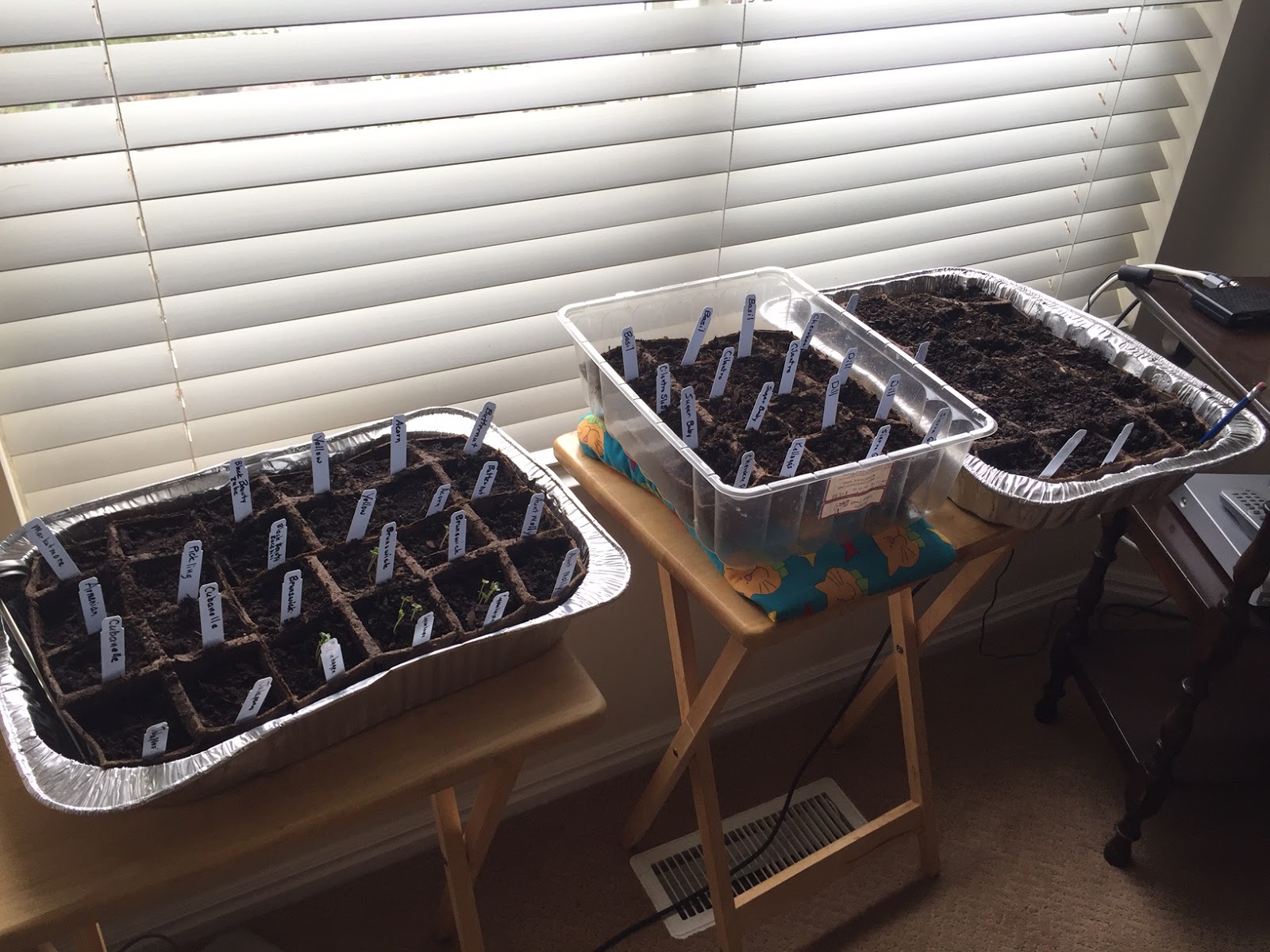
These are my Aunt and Uncle.  They are enthusiastic vegetable gardeners and they like to start seeds indoors in the spring.  It saves some money on plants, gives them a jump on the season and gives them a sense of satisfaction in the knowledge that "we grew it" - from a tiny seed to the dinner table!
I asked them recently about their experience with starting seeds indoors (successes and failures, etc. ) and here is what they wrote (see pictures below):

We like the little green house we got from Home Depot. About $40. We’ve seen them at Smith’s and Lowe’s and other garden centers. There are bigger ones and smaller ones. In the picture, you’ll see we’ve rigged up lights and fans on power strips and with a timer.

We started with seed plantings in March, following the instructions on the packages about germination times, maturity times, temperature sensitivities, etc. If started too early plants can get very leggy

The pictures show the progress through establishment, hardening off, and delivery to the garden.

We generally had good luck with winter and summer squash, Tomatillos, cabbage, Brussels sprouts, cucumbers, melons, cantaloupe, Flowers (4 o’clocks, marigolds, nasturtiums, etc).

We haven’t had good luck with peppers nor tomatoes. A friend of ours started Tomatoes early and tended them until after Mother’s day and they did ok…We’re going to let the stores do the work on tomatoes and peppers. Our Aunt Nelly’s Ground Cherry failed to sprout at home.




Tuesday, January 17, 2017

Which Vegetable Seeds Should I Plant In The Ground And Which Should I Start Indoors?


This can be a little confusing and there are no rules set in stone.  What works for one gardener might not work for another.  And the gardening police aren't going to show up and tell you you've done it all wrong.  Don't be afraid to experiment.   Just be aware that (as with all gardening) there can be some failure.  Don't let it get you down.  Be joyous about the successes!

I have made some general lists of seeds to start indoors and seeds to plant in the garden and plants to purchase at your local independent nursery.  You will see that some vegetables appear on both (or all three) lists.  Be sure to read the seed packet instructions and know your average last frost date.

Vegetable seeds to plant directly in the garden:
*all root vegetables (carrots, beets, radishes)
potatoes (from seed potatoes, not seeds)
beans
swiss chard
corn
cucumbers
all greens
cucurbits (gourds, melons, pumpkins, squash, cucumbers)
basil
cilantro
lettuce
peas
spinach
okra
onions (sets or starts)
leeks (starts)
garlic (in the fall)

Vegetable seeds to start indoors:
lettuce
cabbage
tomatillos
cucurbits (gourds, melons, pumpkins, squash, cucumbers)
basil
onions
tomatoes
swiss chard
cauliflower
eggplant
leeks
peppers
okra
*no root vegetables

Vegetable plants to buy at the plant nursery:
In March and April:
cauliflower
cabbage
broccoli
brussels sprouts
kale
In May and June:
tomatoes
eggplant
peppers
tomatillos
okra


Wednesday, January 11, 2017

When Can I Plant Seeds In The Garden In Utah? Get To Know Your Average Last Frost Date

garden seeds!!

Winter is a great time to plan your vegetable garden and buy seeds.  It's important to prepare for the timing of the plantings as well as the locations.  The calendar for planting seeds directly in the garden revolves around the average last frost date in your area:

-  This is the date marking the end of freezing nights (in late spring).
-  It's safe for the rest of the summer to grow tender plants outside in the garden.  
-  Some seeds can be planted weeks or months before this date and some seeds can only be planted after this date.

Along the Wasatch Front, the average last frost date is around the middle of May.  (Mother's Day is a good way to remember it).   A great way (maybe the best way) to find out the date for your specific area is to ask some of your gardening neighbors.

Once you know the average last frost date for your area, you can plan your seed planting.  Here are some tips:
     - read the directions on the back of your seed packets.  There is a lot of information on the package about how to sow, thin and water the seeds.
     - the seed packets will tell you how many weeks before or after the average last frost date you should plant the seeds.  This will help you with your planting calendar.
      - save the seed packets so you can remember the varieties of vegetables you planted and the dates you planted them.   You can refer to the instructions if needed.  You can make notes about successes and failures.
     - check with your local independent garden center to see if they have a spring planting guide.  It's a chart that tells you when to plant what in your area.  Here is a link to an example of a planting guide from Utah State University.  And here is a link to a post on this blog about which seeds to start indoors and which seeds to plant in the ground.
Here is a picture of some helpful instructions on a seed packet:
seed packets have planting instructions

 seed packets have lots of gardening information

Tuesday, November 8, 2016

Top 10 Fall-Flowering Waterwise Perennials For Utah

Here is a list of 10 perennials that are water wise and fall-flowering.  They will provide color in your drought tolerant garden in late summer and fall.  Keep the spent flowers trimmed off (deadheading) and they will bloom right up until the first frost - sometime in October or early November.

Fall blooming Anemone


Mums


Plumbago


Gaura


Sedum


Zauschneria


Caryopteris


Buddleia


Hardy Hibiscus


Roses

Thursday, March 24, 2016

Annuals For The Spring Garden In Utah - When Can We Plant Pansies, Ranunculas, English Daisies and Johnny Jump Ups?

March is the time to plant spring-flowering annuals among your spring-flowering bulbs (the tulips, daffodils, crocus and hyacinths that you planted in October).  Some excellent choices for spring annuals are pansies, ranunculus, English daisies and johnny jump ups.  
*These plants are temporary - they thrive and flower like crazy in the cool weather.  But as soon as it gets hot (May on the Wasatch Front in Utah) they shut down.  Then it's time to remove them and plant summer annuals for warm weather color, like petunias, marigolds, geraniums, etc.   
*The cool-weather-loving annuals can tolerate cold nights and spring frosts.   The summer annuals cannot.  They must be planted after our average last frost date - somewhere around Mother's Day or May 10.  

pansies planted among the tulips on Temple Square in Salt Lake City

pansies for spring color

ranunculus for spring color in Utah

johny jump ups - spring flowers  

Sunday, August 9, 2015

Can I Start A Vegetable Garden In August, In Utah?

We usually have a long Autumn in Utah - from early September until sometime in November when it turns cold and wintery.  The average date of the first frost on the Wasatch Front is around the middle of October, but it may not bring a permanent end to the growing season.  The ground is still warm and the weather often warms up again for a few more weeks.  Plants can be covered at night when a cold snap is expected.  So this means, yes, you can plant some cool season vegetables in August for a fall crop!  Planting seeds for lettuce, cilantro, spinach, carrots, radishes, beets, peas, kale, chard, arugula - anything that grows quickly and likes cooler weather.
Plant cool-season crops from seed in August for a fall harvest in Utah

Wednesday, October 22, 2014

When Is The Average First Frost Date In Utah?

The average first frost (or freeze) date for the Wasatch Front in Utah is around the middle of October. This means that around this time a hard freeze will cause your garden plants to die if they are annuals or they are not cold-hardy.  You can pull them out before this happens or you can wait until after it happens.  If you wait until after the first frost of fall to pull out your plants, you can enjoy them right up until the last day before it freezes - fall flowers and fall vegetables.
Perennials (plants that grow back every year) can be cut back in the fall, but I think it's better to wait until spring;  let them die back naturally over the winter.
Fall Garden at the Dallas Arboretum

Saturday, May 10, 2014

When Can I Plant Tomatoes (and other tender vegetables) In Utah?

On the Wasatch Front, anytime after Mother's Day it is usually safe to plant tender vegetable plants.  However, it's a good idea to watch the weather forcasts and make sure that nighttime temperatures aren't expected to go lower than the low 30's F.   Here is a post I wrote about frost dates.  Also, if you purchase plants that have become accustomed to the luxurious and constant-temperatured lifestyle of a nursery greenhouse, they will need to be "hardened off".  This is a process of placing seedlings outside during the day and moving them inside during the night.  They toughen up with the exposure to the outside air.  Then they won't be so shocked when transplanted into the garden.  Here is an article about hardening off plants.

seedlings almost ready for May planting!

Thursday, May 23, 2013

Growing Peppers In Utah

Peppers Grow Well In Utah!


Every good garden should have at least a few varieties of peppers.  From Sweet Bells to Jalapenos and Hot Habaneros, all kinds of peppers grow well in Utah.   Like all warm season vegetables, peppers should be planted after the average last frost date, which is around May 15 for the Wasatch Front.  Pepper plants like full sun (at least 4 hours of mid-day sun) and regular deep watering (2 or 3 times a week).  Most peppers have green fruits that turn red or yellow or purple as they ripen.  They are edible at any stage, but they often develop more sweetness and heat the longer they are left on the plant.
A good collection of peppers might include:
pasilla
bells, yellow, purple and green (which will turn red if left on the plant to ripen)
jalapeno
serano
thai hot
anaheim
habanero (too hot for me, but some folks like them!)

Fresh Salsa:
*chopped tomatoes (about 2 cups)
chopped onions     (about 2/3 cup)
chopped cilantro    (about 2/3 cup)
chopped jalapenos (about 1/2 cup)
fresh lime juice       (about 1/3 cup)
kosher salt              (about 1 teaspoon, or a little less and taste it)
*you can substitute chopped fresh pineapple for the tomatoes


Sunday, May 6, 2012

Taking a Gamble with the Frost Date

There is always a chance that the last frost will be earlier than average.  So you could roll the dice and plant early.  If you win, your plants get a head start and you might be harvesting sooner rather than later.  However, there is also always that chance the the last frost will be later than average.  If you roll the dice and you lose, you might be outside at night putting plastic and blankets and newspapers over your plants (which can damage the plants).  Or worse, you might be spending your time and money all over again replacing dead plants.

Saturday, May 5, 2012

What is the "Average Last Frost Date"?

Exactly that.  It is the date by which the last frost occurs in the Spring, on average.  So for the Salt Lake area, that date is around Mother's Day or May 10.  The average last frost date is important because you want to wait until danger of frost is past before you plant your warm-season, tender plants.  The nurseries are loaded right now with plants like basil, tomatoes, impatiens, geraniums and squash plants.  Don't be tempted!!  If you were to plant tender plants too early they could be killed by low temperatures (28 degrees F).   Ask your gardening neighbors about the frost dates in your neighborhood because they can
vary, depending on where you are.