 |
| Fresh Homegrown Dill |
Showing posts with label vegetable gardening. Show all posts
Showing posts with label vegetable gardening. Show all posts
Friday, August 9, 2019
Harvesting Dill!

Wednesday, November 22, 2017
When Should I Cut Down Asparagus Plants In Utah?
After you have harvested some asparagus spears in the spring (careful not to cut them all from one plant), you need to stop harvesting in early or mid June. Let the plants grow up from the late spears and they will turn into huge green ferny things. These large asparagus plants will nurture and feed the crowns from which they grew. In the fall, after the ferny parts have turned yellow and sent their energy back into the crowns and roots, you can cut them to the ground. But not before they turn yellow. In Utah, this happens sometime in October. After you cut the asparagus plants to the ground, it's a good time to put two or three inches of rich compost on top of the asparagus crowns.
 |
| asparagus plants can be cut back after they turn yellow and die back |
Sunday, September 3, 2017
Tomato Harvest 2017! Time for pico de gallo!
September is here and the tomato harvest is ON. This year I only grew one tomato plant, but it just keeps cranking out big ripe tomatoes! A friend gave me a bunch of heirloom tomatoes, too. I'll be making my favorite salsa today:
Pico de Gallo:
chopped fresh tomatoes
chopped onion
chopped cilantro
chopped jalapeno (and serano, if you like it hot)
lime juice and salt
Maybe the super hot summer made for a bumper crop this year!
Pico de Gallo:
chopped fresh tomatoes
chopped onion
chopped cilantro
chopped jalapeno (and serano, if you like it hot)
lime juice and salt
Maybe the super hot summer made for a bumper crop this year!
 |
| heirloom tomatoes - Utah harvest! |
 |
| Utah tomato harvest - 2017 |
Sunday, June 11, 2017
Top Seven Herbs To Grow In Utah - Herb Gardening For Beginners!
June is a great time to start an herb garden. If you are a beginner gardener and you feel a little overwhelmed by all of the possibilities, herb gardening is a great place to start. And, if you like to cook, you need an herb garden. There are many herbs that will grow well in Utah - here is a list of seven of the easiest and most useful. They are available as small plants at your local independent garden centers. You can use these herbs in your kitchen this summer and throughout the year if you dry them! Herb plants are beautiful; incorporate them into your perennial beds. They produce flowers that create food for bees, butterflies and other pollinators.
Basil - Ocimum basillicum: Basil has been cultivated for over 5000 years. It's possible that it originated in India but it has become a major component of the cuisines of Southern Europe and Southeast Asia. There are many flavors and varieties. I like to grow some Thai basil for Asian dishes and lots of Italian (Genovese sweet basil) for pesto, tomato sauce and eggplant parmesan. Experiment with several varieties to see what you like. Basil gets 1 to 2 feet tall and wide.
TWO THINGS to remember about basil. No, THREE THINGS.
1. Basil is an tender annual so you need to plant it every year. It will not survive frost. You can buy plants or grow it from seed.
2. Snails and slugs love basil. Keep them away.
3. Snip off the flower buds of basil. Don't let it flower. Basil goes bitter when it flowers.
Mint - Mentha: Mint is a versatile herb! It is used in marinades, desserts, Indian dishes, Greek dishes, sauces for lamb and as a flavoring for iced tea. A sprig of mint in an icy gin and tonic on a warm evening is awesome. There are many varieties of mint available at the nurseries. If you want to grow a few different mints to see which ones you like best, plant them in pots and taste test them all summer. If you grow mint in the ground - !!Caution!! Mint plants are perennial and they will spread aggressively under ground. This is why it's best to grow mint in large pots.
Chives - Allium shoenoprasum: Chives are members of the edible Allium genus like garlic, onion, shallot, leeks and scallions. Perennial and easy to grow, chive flowers are lovely and they will bloom all summer with deadheading. They grow in clumps reaching about 10 or 12 inches tall and the purple flowers make wonderful garnish for food or additions to floral arrangements. The green chive leaves are delicious on potatoes, soups and salads of all kinds. Chopped chives garnish deviled eggs perfectly.
Rosemary - Rosmarinus officinalis: Rosemary is a Mediterranean herb. It's cold hardiness is borderline in Utah. However, there is one variety called "arp" that will survive here. If it is planted in a sunny spot and given some mulch in the fall, chances are excellent that you will have rosemary year after year. It can get quite large (2 - 3 feet tall and wide), so plant it where it has room to grow. Rosemary is great in marinades for grilling pork, chicken or beef. It also goes into the Thanksgiving turkey stuffing. It can be easily dried and used all year.
Thyme - Thymus vulgaris: The Ancient Egyptians used thyme for embalming and many cultures through the centuries used thyme to promote courage. I like to use thyme in soup or with chicken. There are lots of varieties of thyme - some creeping and some with different colors and flavors. For cooking, I like just the plain English Thyme. It's low-growing (6 or 8 inches tall and 10 or 12 inches wide). It is perennial but it sort of wears out after a few years so you might need to replace it.
Parsley - Petroselinum crispum: Parsley is native to the Mediterranean region. It is a biennial which means that it lives for two growing seasons. The first year, parsley grows only foliage. The second year, parsley grows some foliage and some tall thick stems that produce flowers and seeds. Then the plant will die. So they need to be replaced. I like to plant one or two every year so there are always some plants at each stage of their life cycle. Try the curly parsley and the Italian flat-leaf parsley. Great for garnish, salad, soups, most Italian dishes and juicing.
Sage - Salvia officinalis: This handsome mediterranean herb is a perennial and will survive our cold Utah winters. It gets large (2 - 3 feet tall and wide!), but you can trim it back all summer long. Just don't trim it in the fall. Use fresh in soups and stews or cut and dry the leaves to use in your Thanksgiving stuffing. This plant loves sun and heat. Great for the water wise perennial bed.
Basil - Ocimum basillicum: Basil has been cultivated for over 5000 years. It's possible that it originated in India but it has become a major component of the cuisines of Southern Europe and Southeast Asia. There are many flavors and varieties. I like to grow some Thai basil for Asian dishes and lots of Italian (Genovese sweet basil) for pesto, tomato sauce and eggplant parmesan. Experiment with several varieties to see what you like. Basil gets 1 to 2 feet tall and wide.
TWO THINGS to remember about basil. No, THREE THINGS.
1. Basil is an tender annual so you need to plant it every year. It will not survive frost. You can buy plants or grow it from seed.
2. Snails and slugs love basil. Keep them away.
3. Snip off the flower buds of basil. Don't let it flower. Basil goes bitter when it flowers.
 |
| Sweet Basil |
Mint - Mentha: Mint is a versatile herb! It is used in marinades, desserts, Indian dishes, Greek dishes, sauces for lamb and as a flavoring for iced tea. A sprig of mint in an icy gin and tonic on a warm evening is awesome. There are many varieties of mint available at the nurseries. If you want to grow a few different mints to see which ones you like best, plant them in pots and taste test them all summer. If you grow mint in the ground - !!Caution!! Mint plants are perennial and they will spread aggressively under ground. This is why it's best to grow mint in large pots.
 |
| mint grows in Utah |
Chives - Allium shoenoprasum: Chives are members of the edible Allium genus like garlic, onion, shallot, leeks and scallions. Perennial and easy to grow, chive flowers are lovely and they will bloom all summer with deadheading. They grow in clumps reaching about 10 or 12 inches tall and the purple flowers make wonderful garnish for food or additions to floral arrangements. The green chive leaves are delicious on potatoes, soups and salads of all kinds. Chopped chives garnish deviled eggs perfectly.
 |
| chives grow well in Utah! |
Rosemary - Rosmarinus officinalis: Rosemary is a Mediterranean herb. It's cold hardiness is borderline in Utah. However, there is one variety called "arp" that will survive here. If it is planted in a sunny spot and given some mulch in the fall, chances are excellent that you will have rosemary year after year. It can get quite large (2 - 3 feet tall and wide), so plant it where it has room to grow. Rosemary is great in marinades for grilling pork, chicken or beef. It also goes into the Thanksgiving turkey stuffing. It can be easily dried and used all year.
 |
| rosemary 'arp' will grow in Utah |
Thyme - Thymus vulgaris: The Ancient Egyptians used thyme for embalming and many cultures through the centuries used thyme to promote courage. I like to use thyme in soup or with chicken. There are lots of varieties of thyme - some creeping and some with different colors and flavors. For cooking, I like just the plain English Thyme. It's low-growing (6 or 8 inches tall and 10 or 12 inches wide). It is perennial but it sort of wears out after a few years so you might need to replace it.
 |
| thyme grows in Utah |
Parsley - Petroselinum crispum: Parsley is native to the Mediterranean region. It is a biennial which means that it lives for two growing seasons. The first year, parsley grows only foliage. The second year, parsley grows some foliage and some tall thick stems that produce flowers and seeds. Then the plant will die. So they need to be replaced. I like to plant one or two every year so there are always some plants at each stage of their life cycle. Try the curly parsley and the Italian flat-leaf parsley. Great for garnish, salad, soups, most Italian dishes and juicing.
 |
| parsley - easy to grow in Utah |
Sage - Salvia officinalis: This handsome mediterranean herb is a perennial and will survive our cold Utah winters. It gets large (2 - 3 feet tall and wide!), but you can trim it back all summer long. Just don't trim it in the fall. Use fresh in soups and stews or cut and dry the leaves to use in your Thanksgiving stuffing. This plant loves sun and heat. Great for the water wise perennial bed.
 |
| Sage grows in Utah! |
Monday, May 15, 2017
When Can I Plant Tomatoes In Utah?
Tomatoes can be planted in mid to late May in Utah, after there is no more danger of frost. Find out the average last frost date for your area and watch the weather forecast. If you plant tomatoes and other tender vegetables and you find out it might freeze, you can cover your garden with plastic, frost cloth or sheets over night to protect the plants. Make sure you remove these coverings first thing in the morning.
It's also true that you can plant tomatoes anytime up until about the first of July in Utah. The plants will grow fast during the hot part of summer and provide fresh tomatoes in the fall!
It's also true that you can plant tomatoes anytime up until about the first of July in Utah. The plants will grow fast during the hot part of summer and provide fresh tomatoes in the fall!
 |
| tomatoes grow well in Utah! |
Saturday, May 13, 2017
When Can I Plant Cucumbers In Utah?
Cucumbers are tender vegetable plants and they cannot be planted until all danger of frost gone. This is usually around the middle to the end of May in Utah. Here is a post I wrote about frost dates. And here is a post I wrote about vegetable planting - some general guidelines for timing, etc. Hopefully this will help you avoid some unnecessary problems (plant death) during spring planting. It's difficult , I know, for gardeners to restrain themselves from planting too early. It's such a wonderful time of the year and planning and planting the vegetables is so fun. And the nurseries are loaded with tons of plants. The whole thing is irresistible. We just need to make sure the right time has arrived!
 |
| Home grown pickling cucumbers! Cucumbers grow well in Utah! |
Monday, May 8, 2017
What Does "tender vegetables" Mean? In Gardening?
The phrase "tender vegetables" or "tender plants" refers to plants that cannot tolerate temperatures below freezing. If you plant these plants too early in the spring, they will not survive the cold nights. It is important to understand the average last frost date for your area so that you can avoid planting tender plants too early.
How do we know if a plant is tender? Seed packets and plant tags will tell you when it is safe to plant specific plants.
Some common examples of tender vegetable plants are: tomatoes, eggplants, peppers, basil, summer squash, winter squash (and pumpkins) and melons.
Also, some annual flowers are tender, like petunias, geraniums, impatiens and marigolds.
Watch the weather forecasts, talk to your neighbors and get to know the microclimate in your area and around your property.
How do we know if a plant is tender? Seed packets and plant tags will tell you when it is safe to plant specific plants.
Some common examples of tender vegetable plants are: tomatoes, eggplants, peppers, basil, summer squash, winter squash (and pumpkins) and melons.
Also, some annual flowers are tender, like petunias, geraniums, impatiens and marigolds.
Watch the weather forecasts, talk to your neighbors and get to know the microclimate in your area and around your property.
 |
| Morning Glory - Tender Plant |
Monday, May 1, 2017
When Should I Plant Raspberries In Utah?
April and May are the best times to plant raspberries in Utah. This is when the plants are available in the local independent garden centers and nurseries. You will also find blackberries, boysenberries, strawberries, grapes, gooseberries, artichokes and rhubarb plants - all perennial fruit and vegetable plants. They are best planted int the spring so their roots can become established during the cooler wet weather.
 |
| When should I plant Raspberries in Utah? |
Thursday, April 27, 2017
5 Ways To Save Money In The Vegetable Garden
 |
| vegetable garden in Salt Lake City |
Here are 5 ways you can save money in your vegetable garden:
1 - plant things from seeds when you can. Plants are relatively expensive and seeds will produce plants at a fraction of the cost.
2 - be efficient with water. Drip systems are perfect for the vegetable garden.
3 - be efficient with the harvest. Money and time (and your blood, sweat and tears) have gone into this garden. What a terrible waste if you don't utilize the fruits of the harvest. If there is too much for you and your family, share it with friends and neighbors. Or do some canning and preserving. Your local food pantry will welcome any fresh produce you have to offer.
4 - compost. Make your own compost to feed the soil and plants in your garden. It's much cheaper than buying it.
5 - go organic. Use organic methods to feed your soil and plants and to control pests and weeds. Pesticides, herbicides, synthetic fertilizers and plant foods are expensive and can damage your soil in the long run.
Friday, April 14, 2017
When Can I Plant Corn In Utah?
Corn is a tender vegetable plant, which means that it cannot tolerate temperatures below freezing (32 degrees F or 0 degrees C - the temperature at which water freezes). If it is still freezing at night then it it too cold for tender vegetables. Therefore, you should plant corn starting several weeks before the average last frost date for your area. This way when the tiny plants germinate, they will be safely past that frost date. Generally, the last average frost date for the Wasatch Front is sometime around Mother's Day. You can ask your neighbors or the folks at your local independent garden center when your average last frost date is. You can extend your corn harvest in summer and fall by succession planting your corn seeds.
 |
| Corn Grows In Utah! |
Friday, March 31, 2017
When Should I Plant Cool Season Crops In Utah?
April is the time to plant cool season crops in Utah. Cool season crops are things like lettuce, spinach, broccoli, kale, cabbage, cauliflower and brussels sprouts. The lettuce and spinach can be planted from seed. The broccoli, kale, cabbage, cauliflower and brussels sprouts are purchased as small plants at the garden center and planted right into the vegetable garden in April. Amazingly, these plants will survive a snowstorm or a light frost. They will take off in May and June and by mid summer you will be harvesting them! Cool season vegetables are a great way to expand your production of home grown vegetables.
 |
| home grown broccoli |
Thursday, March 30, 2017
When Should I Plant Rhubarb?
April is the best time to plant rhubarb in Utah. You can buy rhubarb crowns at your local independent plant nursery. Or, if you are lucky, you have a rhubarb-growing neighbor who will let you dig up a crown or two. Rhubarb transplants easily in the spring before the plant has grown big. The cool wet weather of April and May will help it get established. Wait 2 years before harvesting from newly planted rhubarb plants. They need to get strong and well established.
Here is another blog post about rhubarb. Rhubarb is a perennial; it will come back year after year.
Here is another blog post about rhubarb. Rhubarb is a perennial; it will come back year after year.
 |
| plant rhubarb crowns in the spring before the plants are too big |
Wednesday, March 29, 2017
When Should I Plant Strawberry Plants In Utah?
Spring is the time to plant strawberry plants. They are available in the local garden centers in March and April. You will need to decide if you want ever-bearing or June-bearing strawberries. Two years ago I planted an ever-bearing variety called "Ft. Laramie" and they have been outstanding! I had fresh strawberries on and off all summer! Strawberries grow very well in Utah!
 |
| Ft. Laramie strawberries! Grown in Utah! |
Tuesday, March 28, 2017
When Can I Plant Beets in Utah?
Beets grow well in Utah. In fact, they were grown commercially here for many decades. The Utah sugar industry was based on locally grown and processed sugar beets. The history of sugar production in Utah and Idaho is interesting, but way too long and involved to discuss in this blog post.
The beets we enjoy growing in our home gardens are nothing like sugar beets (big, gnarly white beets). There are wonderful red and orange and striped varieties that are small, tender and sweet - perfect for cooking and canning. Some excellent beet varieties are: bull's blood, chioggia, Detroit dark red and golden boy. And beet greens are edible, too!
Beets can be planted in late March and early April. They work best when planted by seed directly into the garden. Succession planting is a good idea if you want to harvest over a longer period of time in the summer.
The beets we enjoy growing in our home gardens are nothing like sugar beets (big, gnarly white beets). There are wonderful red and orange and striped varieties that are small, tender and sweet - perfect for cooking and canning. Some excellent beet varieties are: bull's blood, chioggia, Detroit dark red and golden boy. And beet greens are edible, too!
Beets can be planted in late March and early April. They work best when planted by seed directly into the garden. Succession planting is a good idea if you want to harvest over a longer period of time in the summer.
 |
| beets grow well in Utah - plant them in April |
Monday, March 27, 2017
How And When Do We Thin Seedlings?
This can be an emotionally painful experience for some gardeners - pulling out some of the seedlings in order to allow enough space for others to grow. After planting seeds and dutifully watering, watching, waiting and hoping over them and they finally sprout from the surface of the earth, it seems just so horrible to have to destroy any of them! But it must be done in order to have a successful crop.
The best time to thin seedlings is right after germination so the new root systems won't have so much competition. Some crops will need thinning several times.
The best way is to find out the spacing/thinning recommendations on the seed packets and pull out the seedlings in-between the recommended intervals.
You can use a measuring tape as a guide or you can eyeball it. See the before and after photos below of radish seedlings.
Get it over with - the sooner, the better.
The best time to thin seedlings is right after germination so the new root systems won't have so much competition. Some crops will need thinning several times.
The best way is to find out the spacing/thinning recommendations on the seed packets and pull out the seedlings in-between the recommended intervals.
You can use a measuring tape as a guide or you can eyeball it. See the before and after photos below of radish seedlings.
Get it over with - the sooner, the better.
 |
| thinning radish seedlings - before |
 |
| thinning radish seedlings - after |
Sunday, March 19, 2017
Succession Planting For The Home Vegetable Garden
Succession Planting can mean several different things. I want to talk about succession planting for the home garden - for small crops in small spaces. Some vegetable plants produce harvest all summer and into the fall, like tomatoes, peppers, cucumbers, eggplants and swiss chard. Other vegetable plants are harvestable only once and then they are all done for the season - like lettuce, beets, peas, and radishes, for example. You harvest these vegetables when they are ready and then the plant is either gone (because you dug it up and ate it) or it is not going to flower again (like peas).
With this in mind, think about spreading that harvest time out over a month or two instead of having ALL of the harvest of ONE thing happen within a few days.
We can do this by succession planting - plant some of the seeds for a particular crop one week, then more the next week, more the week after that, etc. By not planting the whole row of peas in one day and instead, spreading the plantings out, you will have small amounts of peas each week from late June through the end of July.
If, however, you are planning on preserving the harvest in some way (like canning or freezing) and you want the harvest to happen all at once, then plant the seeds all at once.
With this in mind, think about spreading that harvest time out over a month or two instead of having ALL of the harvest of ONE thing happen within a few days.
We can do this by succession planting - plant some of the seeds for a particular crop one week, then more the next week, more the week after that, etc. By not planting the whole row of peas in one day and instead, spreading the plantings out, you will have small amounts of peas each week from late June through the end of July.
If, however, you are planning on preserving the harvest in some way (like canning or freezing) and you want the harvest to happen all at once, then plant the seeds all at once.
 |
| harvesting the salad garden |
Saturday, March 18, 2017
When Can I Plant Peas?
The rule of thumb for planting peas - St. Patrick's Day is the day to start plating peas in Utah. They will flower and produce peas in June. Then, in July, you can remove the plants and plant something else in that space - maybe a fall crop of lettuce or spinach. Or maybe more peas!
 |
| plant peas on St. Patrick's Day |
 |
| peas will grow in Utah! |
Wednesday, February 15, 2017
What Does "Germination" Mean?
Germination is "the development of a plant from a seed or spore after a period of dormancy". In other words, it is when a seed "sprouts" and starts to send up stems and leaves. This process is activated in response to moisture and warmth. That's why we have to wait until spring to plant most seeds in the garden - the soil needs to warm up and reach a certain temperature, or the seeds won't sprout.
Most seed packets mention germination in the planting instructions. You might see something there about "soil temperature needed for germination". Garden centers sell soil thermometers so you can take the temperature of your soil. There might also be something about "days to germination". Days to germination is good to know because if it takes two weeks, you won't be worrying and wondering why you don't see the seedlings coming up.
In a nutshell, the warmer the soil is, the faster the germination will happen! And if your soil is dry, you will need to keep it moist.
Most seed packets mention germination in the planting instructions. You might see something there about "soil temperature needed for germination". Garden centers sell soil thermometers so you can take the temperature of your soil. There might also be something about "days to germination". Days to germination is good to know because if it takes two weeks, you won't be worrying and wondering why you don't see the seedlings coming up.
In a nutshell, the warmer the soil is, the faster the germination will happen! And if your soil is dry, you will need to keep it moist.
 |
| thermometer for soil temperature |
 |
| germination - when seeds sprout! |
Saturday, January 21, 2017
Starting Seeds Indoors

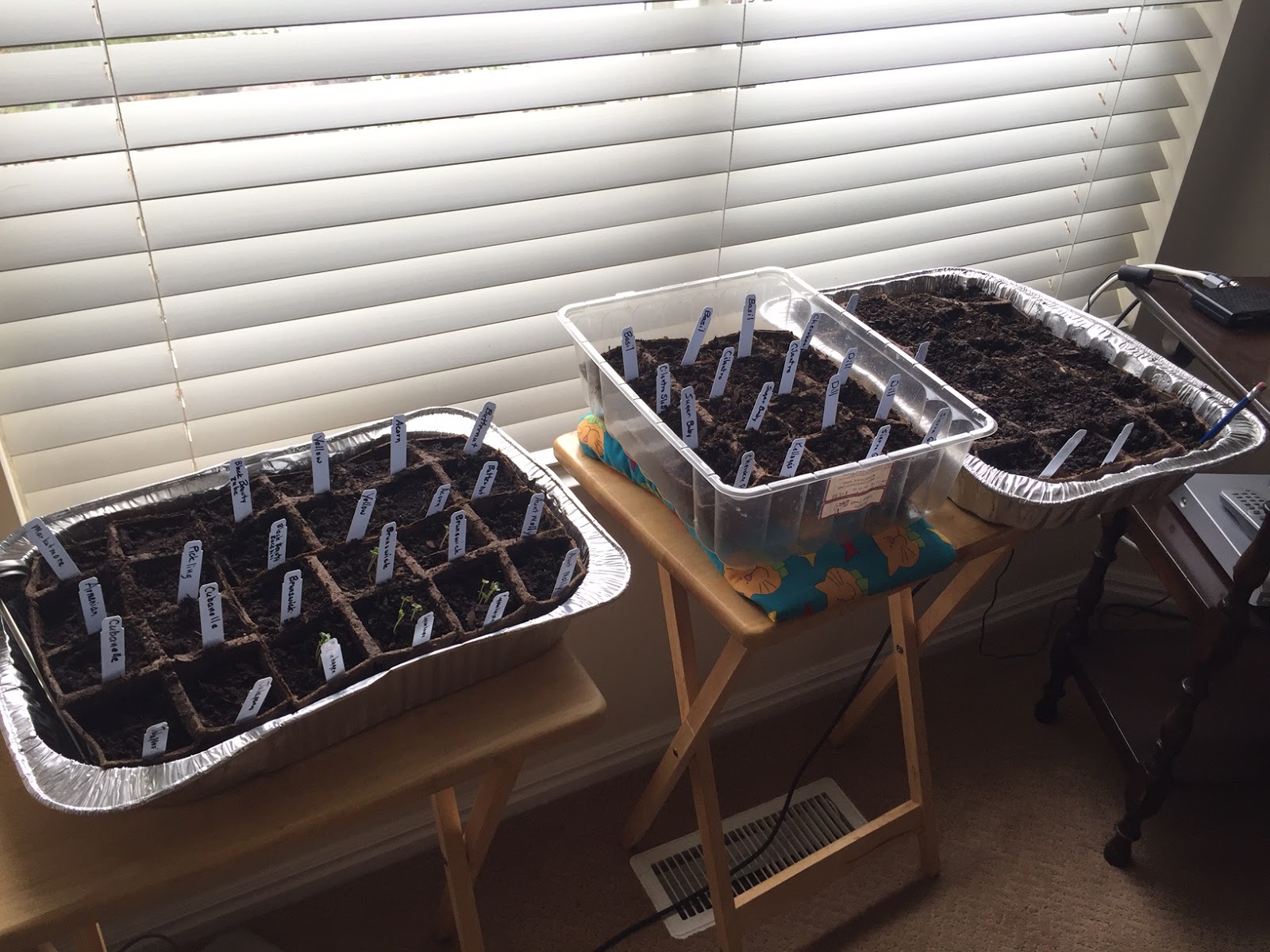
I asked them recently about their experience with starting seeds indoors (successes and failures, etc. ) and here is what they wrote (see pictures below):
We like the little green house we got from Home Depot. About $40. We’ve seen them at Smith’s and Lowe’s and other garden centers. There are bigger ones and smaller ones. In the picture, you’ll see we’ve rigged up lights and fans on power strips and with a timer.
We started with seed plantings in March, following the instructions on the packages about germination times, maturity times, temperature sensitivities, etc. If started too early plants can get very leggy
The pictures show the progress through establishment, hardening off, and delivery to the garden.
We generally had good luck with winter and summer squash, Tomatillos, cabbage, Brussels sprouts, cucumbers, melons, cantaloupe, Flowers (4 o’clocks, marigolds, nasturtiums, etc).
We haven’t had good luck with peppers nor tomatoes. A friend of ours started Tomatoes early and tended them until after Mother’s day and they did ok…We’re going to let the stores do the work on tomatoes and peppers. Our Aunt Nelly’s Ground Cherry failed to sprout at home.




Tuesday, January 17, 2017
Which Vegetable Seeds Should I Plant In The Ground And Which Should I Start Indoors?

This can be a little confusing and there are no rules set in stone. What works for one gardener might not work for another. And the gardening police aren't going to show up and tell you you've done it all wrong. Don't be afraid to experiment. Just be aware that (as with all gardening) there can be some failure. Don't let it get you down. Be joyous about the successes!
I have made some general lists of seeds to start indoors and seeds to plant in the garden and plants to purchase at your local independent nursery. You will see that some vegetables appear on both (or all three) lists. Be sure to read the seed packet instructions and know your average last frost date.
Vegetable seeds to plant directly in the garden:
*all root vegetables (carrots, beets, radishes)
potatoes (from seed potatoes, not seeds)
beans
swiss chard
corn
cucumbers
all greens
cucurbits (gourds, melons, pumpkins, squash, cucumbers)
basil
cilantro
lettuce
peas
spinach
okra
onions (sets or starts)
leeks (starts)
garlic (in the fall)
Vegetable seeds to start indoors:
lettuce
cabbage
tomatillos
cucurbits (gourds, melons, pumpkins, squash, cucumbers)
basil
onions
tomatoes
swiss chard
cauliflower
eggplant
leeks
peppers
okra
*no root vegetables
Vegetable plants to buy at the plant nursery:
In March and April:
cauliflower
cabbage
broccoli
brussels sprouts
kale
In May and June:
tomatoes
eggplant
peppers
tomatillos
okra
Subscribe to:
Posts (Atom)